You help family clients
maximize value, grow and protect
their wealth, and prepare for
transition events.

But across generations—
outcomes become less predictable.

Not because the plan failed.
Because the family system wasn't ready to carry it.

For financial advisors, exit planners, estate attorneys, and succession professionals working with high net worth families.
See the Continuity Dashboard A structured view of continuity before it's tested.
What advisors see — but can't fully structure

You've seen this pattern.

A transition occurs—
a business sale, liquidity event, trust distribution, inheritance.

Technically, everything works.

But over time—

alignment weakens, decisions slow, relationships strain.

Not because of poor financial planning.
Because those are not the whole system.

This will feel familiar

Patterns that appear
after the plan is in place.

01

A well-structured plan that still doesn't hold

02

A transition that creates more complexity than clarity

03

Decision-making that slows when it matters most

04

Family members who are technically prepared—but not aligned

05

Expectations that shift after the event

None of these are unusual.

They point to a system that was never fully structured to carry what it received.

Continuity Gap

Where advisory work breaks down.

You can see the risk.
You can feel it building.

No consistent way to measure it.
No structure to act on it early.

So the work stays reactive.

And the consequences show up after the transition:

Post-transition consequences
  • Retention pressure
  • Fragmentation of assets
  • Loss of alignment
  • Unclear decisions
Reframe

This isn't a financial, legal, or tax problem.

It's a continuity problem inside the family system.

Wealth doesn't transition in isolation.

It transfers into a system that must be able to sustain:

Alignment
Communication
Leadership
Trust
Decision-Making

And when that system isn't ready—

it gets exposed.

You're not missing the plan.
You're missing the structure behind it.

Shift

Value can be created.
Value can be transferred.

Continuity determines whether it holds.

Without continuity structure
  • Reactive advisory posture
  • Subjective risk assessment
  • Isolated, transactional engagements
  • Outcomes visible only after the event
With continuity visibility
  • Proactive, structured advisory
  • Measurable readiness before transition
  • Long-term continuity-centered relationships
  • Structural insight informing every conversation
Why Now

The gap between planning
and outcomes is widening.

Wealth is moving across generations at increasing scale.

Families are taking on greater complexity:

Dimension 01

More stakeholders involved in every decision

Dimension 02

More decisions required across longer time horizons

Dimension 03

Greater complexity in governance and structure

But the structures required to sustain continuity have not kept pace.

The gap between planning and outcomes is widening.

The Solution

Continuity improves when capability
is built through governance.

Most advisors are already helping families create value, prepare for transition, and protect what has been built.

What has been missing is a structured way to strengthen the family system that must carry it forward.

Continuity
The outcome

What endures when the system has been built to carry it.

Legacy Capability
What must be built

The structured capacity within the family system to sustain continuity across generations.

Governance
The discipline that builds it

The structured, repeatable process that converts intention into observable capability growth.

This is the governing logic behind the Unified Theory of Family Continuity™:
continuity endures when governance strengthens legacy capability over time.

The Family Governance Cycle
The Family Governance Cycle — Intelligence, Architect, Practice & Prove
01
Intelligence

Understand readiness and identify gaps

02
Architect

Translate intelligence into structure and priorities

03
Practice & Prove

Build capability and capture evidence

When governance becomes structured and repeatable,
you can finally see what was previously invisible.

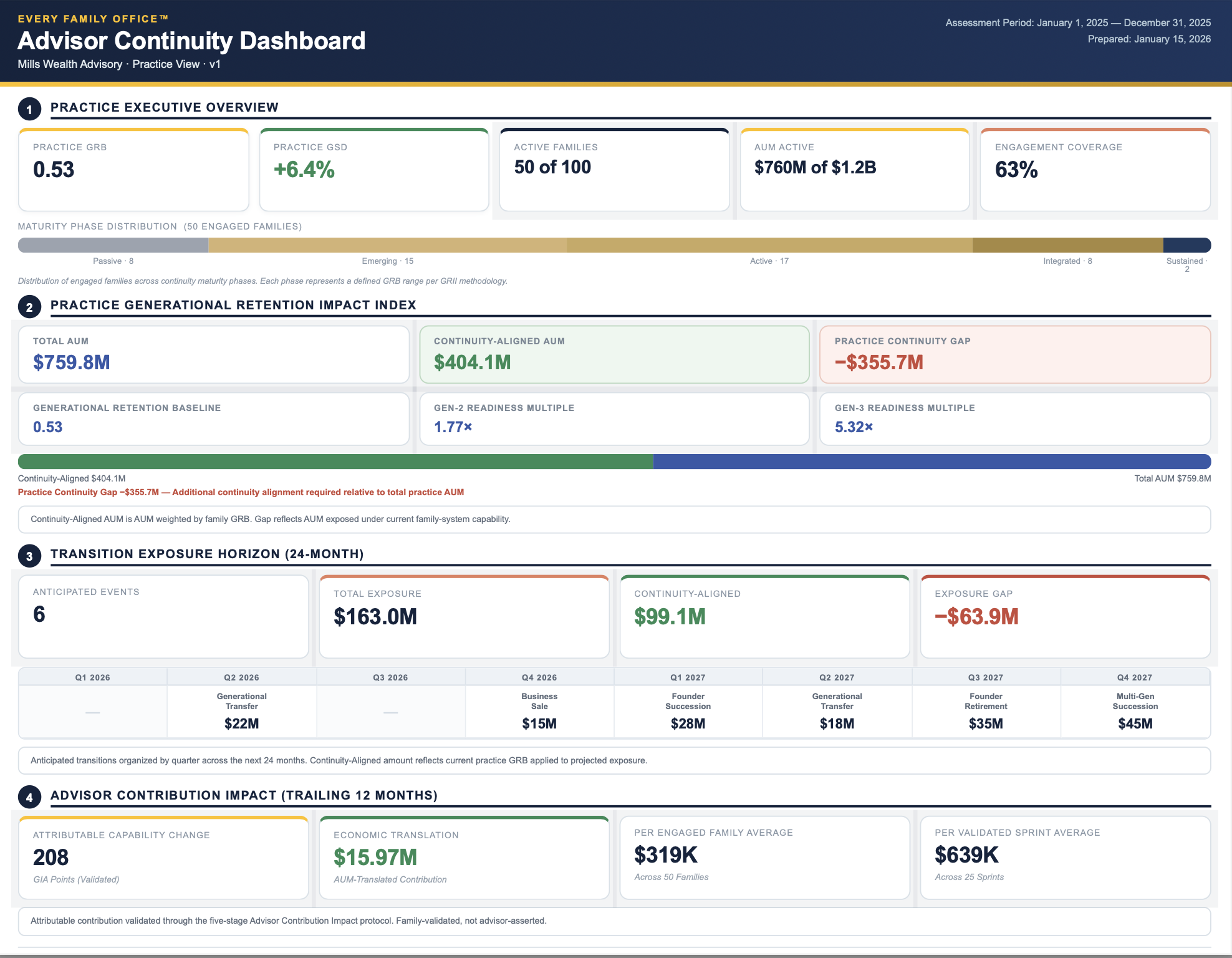
Continuity Dashboard

See clearly.

Where continuity is strongElements carrying structural weight.

Where it is fragileGaps that exposure will find first.

Where capability is missingStructural constraints before the transition.

Continuity Dashboard
Every Family Office™ Continuity Dashboard
Mills Family  ·  Advisor View  ·  v1 Assessment: March 11, 2026  ·  Prepared: March 30, 2026 Source Modules: GIA  ·  GRII  ·  Scenario Analysis
93 out of 216 Emerging
0.43
GRB
1.43×
Gen 2
4.30×
Gen 3
Legacy Capital Scores
Human
18 / 54
Social
28 / 54
Cultural
21 / 54
Structural
26 / 54
Core Life Element Scores
Family
31 / 72
Financial
32 / 72
Personal
30 / 72
Net Worth
$10.0M
Continuity-Aligned Wealth
$4.3M
Continuity Gap
−$5.7M
Continuity-Aligned $4.3M Net Worth $10.0M
Modeled Event
Business sale / liquidity event
Timeline: 24 months
Transition
$7.0M
Readiness Gap
−$2.7M
Additional alignment required
ReactiveConversations that happen after consequences appear
ProactiveStructured visibility before the transition is tested
SubjectiveRisk that lives in judgment and intuition
StructuredObservable, measurable, actionable continuity data
Advisor Continuity Index

A structured view of how your advisory work
is positioned to influence continuity outcomes.

Most advisors can feel continuity risk when it is forming.

This makes your advisory position visible before transition events expose the consequences.

Scoring Guide
1 Not visible or not in place 2 Limited and inconsistent 3 Partially developed 4 Established but uneven 5 Strong and active 6 Clearly structured and consistently practiced
01
Continuity Visibility

Do you have a structured view of your client's continuity readiness?

Not in placeConsistently practiced
02
Structural Alignment

Do you understand how your client's wealth is positioned relative to continuity risk?

Not in placeConsistently practiced
03
Transition Foresight

Have you identified how approaching transition events may expose continuity risk?

Not in placeConsistently practiced
04
Advisor Attribution

Can you clearly demonstrate your contribution to continuity outcomes?

Not in placeConsistently practiced
05
Execution Discipline

Are your clients consistently operating within a structured governance process?

Not in placeConsistently practiced
Continuity
Visibility
Structural
Alignment
Transition
Foresight
Advisor
Attribution
Execution
Discipline
Continuity Lab

You've seen the signal.
Now structure it.

You understand the risk.

This is where it becomes structured.

Inside the Continuity Lab, visibility turns into action.

You and your clients work on:

Aligning decision-making

Clarifying roles and leadership

Strengthening governance structures

Building continuity capability over time

Not as theory.

As a structured, repeatable process.

So transitions don't just complete—

they hold.


This is not a platform.

It is the missing layer between planning and outcomes.

Limited early access. Advisor-first onboarding.
Resources

If you want to explore the system behind this: